


Neural network
Also written: ANN, MLP neurons, Artificial Neuron, Neural activity, Graph Neural Net, GNN, Recurrent Neural Networks, RNNs
A system of interconnected units, like a digital brain, that AI uses to learn from data and perform tasks.
A neural network is a core part of many AI systems. Think of it as a computer program designed to learn from information, much like a human brain learns from experience.
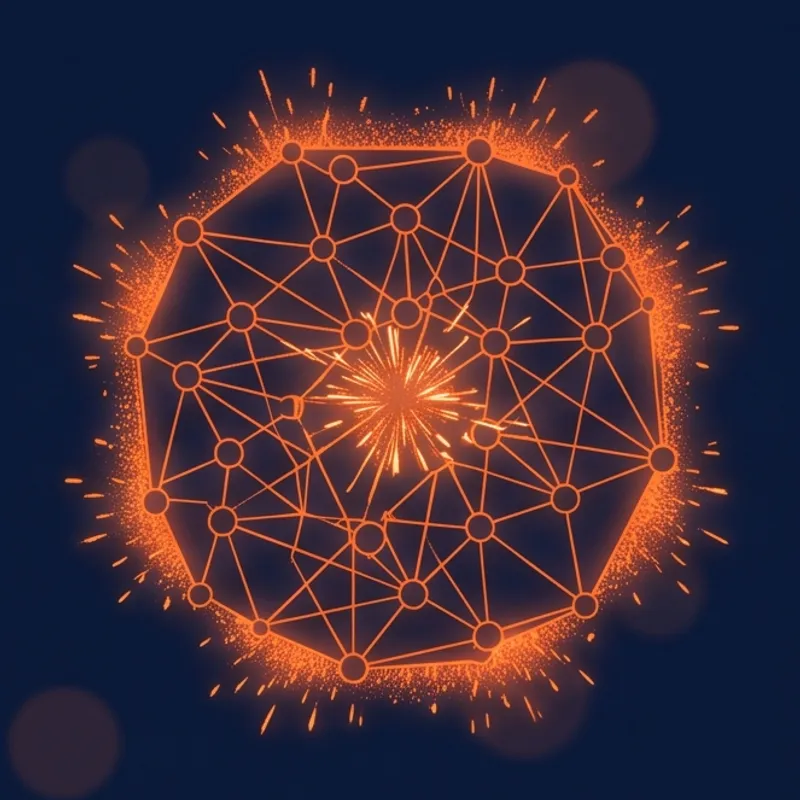
It's made up of many small, interconnected processing units, often called nodes or neurons. These nodes work together, passing signals to each other. By adjusting the strength of these connections based on the data it sees, the neural network learns to recognize patterns, make predictions, or generate new content.
For example, when you upload a photo to an AI that identifies objects, a neural network is likely working behind the scenes. It has been trained on millions of images to learn what different objects look like, so it can tell you if it sees a cat, a dog, or a car.
A neural network is a computational model inspired by the structure and function of biological neural networks. It consists of layers of interconnected nodes (neurons) that process information. Each connection has a weight, and during training, these weights are adjusted to minimize the difference between the network's output and the desired output for a given input.
Different architectures, such as feedforward networks, convolutional neural networks (CNNs), and recurrent neural networks (RNNs), are suited for different tasks. CNNs excel at image processing, while RNNs are used for sequential data like text or time series. The complexity and size of neural networks have grown significantly, leading to models with billions or even trillions of parameters.
Neural networks are the core technology behind modern AI systems. Recent advancements and research, like Anthropic's Golden Gate Claude demo, show how researchers are gaining finer control over these networks to shape AI behavior. The ongoing development of increasingly large and capable models by companies like OpenAI and Google Gemini relies heavily on sophisticated techniques for training these complex neural networks.
- OpenAI buys smartphone camera maker Glass Imaging for $300 million, report saysOpenAI · TechCrunch AI ·
- Toy models of superpositionAnthropic · Anthropic Research ·
- Anthropic commits $10 million to Canadian AI researchAnthropic · Anthropic News ·
- A global workspace in language modelsAnthropic · Anthropic Research ·
- Golden Gate ClaudeAnthropic · Anthropic News ·
- The different levels of how Claude thinksAnthropic · Anthropic on YouTube ·
- Is ChatGPT Conscious? A Pioneer of AI Explains | Dr. Terry SejnowskiOpenAI · Eye on AI ·
- AlphaEvolve: How our Gemini-powered coding agent is scaling impact across fieldsGoogle · Google DeepMind Blog ·
- 10 Years of AlphaGo: The Turning Point for AI | Thore Graepel & Pushmeet KohliGoogle · Google DeepMind: The Podcast ·
- Where wild things roam: Identifying wildlife with SpeciesNetGoogle · Google Research Blog ·
- Titans + MIRAS: Helping AI have long-term memoryGoogle · Google Research Blog ·
- Mapping, modeling, and understanding nature with AIGoogle · Google DeepMind Blog ·
- Teaching Gemini to spot exploding stars with just a few examplesGoogle · Google Research Blog ·
- Using AI to identify genetic variants in tumors with DeepSomaticGoogle · Google Research Blog ·
- Softmax Linear UnitsAnthropic · Anthropic Research ·
- Saving lives with AI health coachingOpenAI · OpenAI News ·
- Techniques for training large neural networksOpenAI · OpenAI News ·
- Dr. Peter Lee: Microsoft Research & IncubationsMicrosoft · Behind The Tech with Kevin Scott ·
- DALL·E: Creating images from textOpenAI · OpenAI News ·
- Oren Etzioni, PhD: CEO of Allen Institute for AIMicrosoft · Behind The Tech with Kevin Scott ·
- Image GPTOpenAI · OpenAI News ·
- AI and efficiencyOpenAI · OpenAI News ·
- JukeboxOpenAI · OpenAI News ·
- Anthropic Claude
- Anthropic's Golden Gate Claude research demo specifically highlighted tuning neural features for precise control over AI behavior.
- Google Gemini
- Google's work on systems like AlphaGo and Gemini is built upon advanced neural network architectures, enabling them to tackle complex problems and understand information.
- OpenAI ChatGPT
- OpenAI has published techniques for training large neural networks, essential for developing powerful models like those used in ChatGPT and DALL·E.
- Artificial intelligence
- AI is a broader field that encompasses neural networks,
- Deep learning
- Deep learning is a subfield of machine learning that uses neural
The concept of artificial neural networks was first proposed in the 1940s, inspired by early understandings of biological neurons. Key developments in the 1980s and 1990s, including backpropagation, laid the groundwork for modern neural networks. Source ↗
Ask an AI chatbot like ChatGPT or Claude to write a short story about a robot learning to paint. Observe how it generates creative text, demonstrating the pattern recognition and generation capabilities of its underlying neural network.
The Playbook: reusable how-tos, prompts, configs and tips pulled out of the news.
- PromptRole-play a student struggling with math for AI tutor simulationSimulate a student's math struggles and uncertainty for AI tutor evaluation. · 5 min
- TemplateReusable workflow templates for healthcare teamsTeams can create and share templates for common workflows like documentation or prior authorizations. · 15 min
- TemplateTemplate for building an AI tool tailored to your workA structured approach to defining and building a custom AI tool for specific business needs. · 15 min
- TemplateEvals CSV prompt list for agent skillsA CSV file template for listing prompts used in evaluating agent skills. · 20 min
- HeuristicDouble coding agent task completion with docs linksProviding coding agents with a documentation link significantly increases their task completion rate. · 2 min
Questions people ask
- Are neural networks the same as AI?
- Neural networks are a type of AI, but not all AI uses neural networks. They are a powerful tool within the broader field of artificial intelligence.
- How do neural networks learn?
- They learn by processing large amounts of data and adjusting the connections between their internal units to improve accuracy on specific tasks, a process often called training.
First seen on Subvolts Apr 30, 2020. Updated Oct 12, 2026. Written by an AI model from the items above and reviewed against them weekly; report an error.