


Mixture of expert
Also written: MoE, MoE models, Latent-MoE, Latent Mixture-of-Experts
A neural network architecture using multiple specialized subnetworks, called experts, guided by a router to process inputs efficiently.
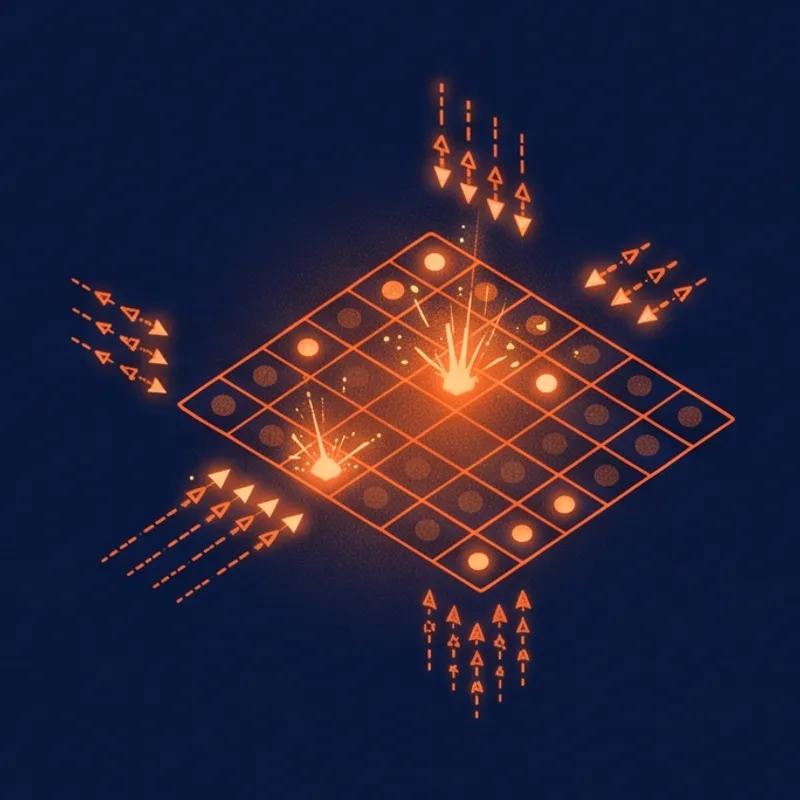
Mixture of Experts (MoE) is a way to build large AI models. Instead of one giant network trying to do everything, MoE uses several smaller, specialized networks, or 'experts.' Think of it like a team of specialists where each expert is good at a particular type of task.
When the AI gets a request, a 'router' or 'gating network' decides which expert or experts are best suited to handle it. This allows the model to be very large and capable, but only activate the necessary parts for each specific task. This can make it faster and more efficient than a similarly sized model where all parts are always active.
For example, one expert might be good at writing code, another at summarizing text, and a third at answering factual questions. The router directs your prompt to the right expert(s) for the job.
Mixture of Experts (MoE) is a model architecture that combines multiple feed-forward networks, termed 'experts.' A gating network dynamically selects which experts process each input token. This approach allows for models with a vast number of parameters, potentially improving performance and efficiency by activating only a subset of parameters per inference step.
The primary tradeoff involves increased complexity in training and routing, but it enables scaling to trillions of parameters while keeping inference costs manageable compared to dense models of equivalent size. Current large models often employ sparse MoE architectures.
Mixture of Experts (MoE) models are gaining traction as frontier AI labs seek more efficient ways to scale up their large language models. This architecture allows models to activate only specific parts of their network for a given task, potentially reducing computational costs and improving performance. Recent mentions suggest MoE is a key area of development for companies aiming to push the boundaries of AI capabilities.
- #260 - Muse, Misalignment, MathOpenAI · Last Week in AI ·
- Understand the Gemma 4 model familyGoogle · Google for Developers on YouTube ·
- #253 - Opus 5, Gemini 3.6, Kimi K3, Hugging Face HackAnthropic · Last Week in AI ·
- LWiAI Podcast #252 - GPT 5.6, Grok 4.5, Nemotron-Labs-Diffusion, AI 2040xAI · Last Week in AI ·
- Last Week in AI #251 - Mythos Back, Sonnet 5, Etched, LongCatAnthropic · Last Week in AI ·
- LWiAI Podcast #248 - Opus 4.8, MAI, Anthropic IPO, Minimax-M3Anthropic · Last Week in AI ·
- Meta’s Path To AI Relevance, According To Meta CTO Andrew BosworthMeta · Big Technology ·
- #251 - Mythos Back, Sonnet 5, Etched, LongCatAnthropic · Last Week in AI ·
- DiffusionGemma: 4x faster text generationGoogle · Google DeepMind Blog ·
- DiffusionGemma: 4x faster text generationGoogle · The Keyword: Developers ·
- Introducing Gemma 4 12B: a unified, encoder-free multimodal modelGoogle · Google DeepMind Blog ·
- Introducing Gemma 4 12B: a unified, encoder-free multimodal modelGoogle · The Keyword: Developers ·
- Some ideas for what comes next, May 2026Google · Interconnects (Nathan Lambert) ·
- #243 - GPT 5.5, DeepSeek V4, AI safety sabotageOpenAI · Last Week in AI ·
- LWiAI Podcast #242 - ChatGPT Images 2.0, Qwen 3.6 Max, Kimi-K2.6OpenAI · Last Week in AI ·
- #242 - ChatGPT Images 2.0, Qwen 3.6 Max, Kimi-K2.6OpenAI · Last Week in AI ·
- Gemma 4: Byte for byte, the most capable open modelsGoogle · Google DeepMind Blog ·
- LWiAI Podcast #238 - GPT 5.4 mini, OpenAI Pivot, Mamba 3, Attention ResidualsOpenAI · Last Week in AI ·
- #238 - GPT 5.4 mini, OpenAI Pivot, Mamba 3, Attention ResidualsOpenAI · Last Week in AI ·
- LWiAI Podcast #237 - Nemotron 3 Super, xAI reborn, Anthropic Lawsuit, Research!Anthropic · Last Week in AI ·
- #237 - Nemotron 3 Super, xAI reborn, Anthropic Lawsuit, Research!!!Anthropic · Last Week in AI ·
- Anthropic Claude
- Anthropic's Opus 5, Sonnet 5, and Fable 5 models are discussed in contexts of new releases and benchmark gains, suggesting that MoE might be an underlying architecture enabling these advancements or offering specialized capabilities.
- Google Gemini
- Google's Gemma 4 model family is noted as offering diverse open-source models for multimodal AI development, implying potential use or exploration of MoE architectures for specialized tasks within the family.
- OpenAI ChatGPT
- OpenAI is mentioned in relation to GPT-5.6, a model that could potentially incorporate MoE principles to manage its complexity and improve efficiency.
- Ensemble Learning
- Ensemble methods combine multiple independent models, whereas
- Modular Neural Networks
- While both use distinct components, MoE specifically re
- Multi-task Learning
- Multi-task learning trains a single model on multiple tasks
The Mixture of Experts concept was introduced in the paper 'Explosive Expertise: An Efficient Learning Scheme for Artificial Neural Networks' by Jacobs, Jordan, Nowlan, and Hinton in 1991. Source ↗
You can observe the effects of specialized AI by asking a general-purpose chatbot to perform very different tasks in sequence. For instance, ask it to write a poem about a cat, then immediately ask it to explain a complex scientific concept. Notice if there's any lag or if the quality shifts significantly, which could indicate different internal 'experts' being engaged.
The Playbook: reusable how-tos, prompts, configs and tips pulled out of the news.
- PromptRole-play a student struggling with math for AI tutor simulationSimulate a student's math struggles and uncertainty for AI tutor evaluation. · 5 min
- TemplateReusable workflow templates for healthcare teamsTeams can create and share templates for common workflows like documentation or prior authorizations. · 15 min
- TemplateTemplate for building an AI tool tailored to your workA structured approach to defining and building a custom AI tool for specific business needs. · 15 min
- TemplateEvals CSV prompt list for agent skillsA CSV file template for listing prompts used in evaluating agent skills. · 20 min
- HeuristicDouble coding agent task completion with docs linksProviding coding agents with a documentation link significantly increases their task completion rate. · 2 min
Questions people ask
- Is Mixture of Experts a new idea?
- The core concept of Mixture of Experts was introduced in the early 1990s, but it has seen a resurgence and significant advancements with modern deep learning techniques.
- How does MoE make AI faster?
- MoE models are faster because only a fraction of the total parameters are activated for any given input, making computation more efficient than dense models with the same total parameter count.
- Are all large AI models MoE?
- No, not all large AI models use the Mixture of Experts architecture. Many still use dense architectures, but MoE is a popular approach for scaling to very large parameter counts efficiently.
First seen on Subvolts Mar 16, 2026. Updated Oct 19, 2026. Written by an AI model from the items above and reviewed against them weekly; report an error.